
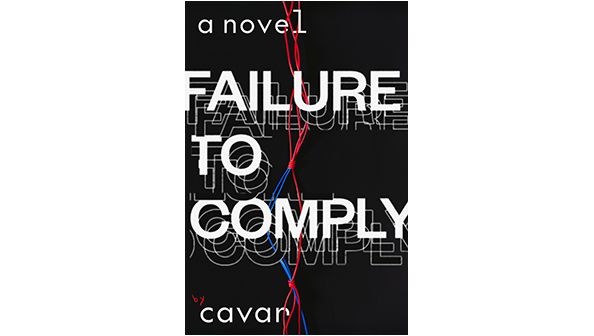
Cavar’s debut novel, Failure to Comply, releases on August 6th from Featherproof. You can pre-order a copy here! “Set in a dystopian, post-apocalyptic future, this literary sci-fi novel presents a world where humans have been unshackled from disease and their basest desires thanks to the genetic engineering and societal supervision of RSCH–an inscrutable entity with unimaginable power (including the ability to literally shape reality). In RSCH’s march toward perfecting the species, however, there are “deviants” (including LGBTQ+ people and people with disabilities) who are fighting for a different vision of humanity.”
They were nice enough to chat with me about the book, including the inspirations behind it and the real-life parallels. This interview contains HEAVY SPOILERS and discusses eating disorders, self-harm/suicidal idealtion and the institutionalization of mental health patients.
Lor Gislason: Where did the initial idea for Failure to Comply come from? How did you work out the details of this world, the RSCH? Because it’s extremely detailed – horrifyingly so for the characters, but fascinating to me as a reader.
Cavar: Honestly, a lot of the linguistic choices I made in the text were pulled directly from psychotherapeutic discourse –– the language of thought-stopping, for example. The gaps emerged in the spaces of unthinkability, unsayability –– these moments in which we are deprived of personhood so profoundly that the only way to express that is with a gap. This is to say that I have, in half-jest, called this book an “autobiography.”
I’m a psychiatric survivor. My experiences of psychiatric incarceration are at the core of this text. Carceral technologies trail and doom all of us, but especially minority people, both within and outside the official “walls” of the institution –– this is what Liat Ben-Moshe calls “the institution yet-to-come.” I’m realizing as I respond to this comment that I wanted to materialize, in some way, this yet-to-come feeling. This is a speculative text, a science fictional text, a horror text. It is also a memoir. I’m not about to compare myself to Jordan Peele, but I recall the way that he once described Get Out: a horror film, but in truth, a documentary.
Lor: Especially when it comes to the “bio enhancements” our main characters choose to undergo: a third arm, and a second stomach – which i’m absolutely obsessed with. It’s described as a flesh sack made with the MC’s breasts after top surgery, creating a sort of stoma…with waste coming from the nipple. They even describe how it leaks and the process of washing it.
Cavar: In regard to the bio enhancements, I chose early on to be heavier on the “fiction” than the “science” aspects of this. I’m not interested in the plausible, at least for the purposes of this story. I’m interested in what imagining different embodied and enminded technologies can do, especially in service of a runaway narrative.
At the same time, I did want to be “realistic” about the material realities of living while Mad, while disabled: I wanted to be honest about Reya’s frustrations, wanting to be understood as whole not in spite but with their stumps; yet also tracing the origin of their disablement to state violence. I enhances their body, but it is not always for the purposes of survival –– sometimes, as with the second stomach, their practices could be described as self-harm, self-starvation, despite emerging from a practice we as readers understand as “gender-affirming.” I and Reya are frustrated with and ultimately accepting (however ambivalently) of each others’ choices. Even if they hurt.
Lor: Which brings me to the difference between the perfect/clean world the RSCH tries to maintain, while the “Uncitizens” choose things that would be considered dirty, strange and impractical.
The use of hormones, too, is openly discussed, with Reya trying both estrogen and testosterone and deciding neither suited them. I think that’s an option a lot of trans and queer folks will appreciate, that there is no one way -to be- .
Cavar: What I am interested in doing is disrupting the binary between purity and impurity, both the one so explicit it at times felt satirical, to me, to write, and the more implicit one we uphold even in nominally radical communities. I’m not only talking about discourse on “respectability politics,” but also our collective unpreparedness to deal with Madness, crisis, harm, etc. in anti-carceral ways.
Part of being out there in the wilds, for Uncitizens, is not only to be “free from” the demands of the literal white-picket-fence imposed by RSCH governance. It is also freedom to hurt themselves and others. It is freedom to do things to their bodies that cause grievous damage and cannot be undone, with no adjudicating authority to determine who was and was not “in their right mind” when making that choice. They pursue more recognizable acts of “transition,” defamiliarized: hygiene can’t be guaranteed, they’re in the woods. (Plus, the category of hygiene, under RSCH doctrine, cannot apply here, anyway. Thought-transformation and material transformation work as one to disorient readers –– at least, I hope).
Basically: the presumption is that, as Uncitizens, they are always and already wrong-minded. But that leaves the question: how do we –– how do they, how do Reya and I, how to Reya and I and me and us –– navigate our love for each other when we all want to die, but when the government somehow wants us deader than our suicidal selves do? I don’t know, so I write.
Lor: In the community, people only consume this chocolate shake for food. Was there any reason for this specifically? I’m thinking of when you use the powder mix and it doesn’t quite dissolve so you get weird lumps.
Cavar: Okay, so: when you’re institutionalized for a restrictive eating disorder –– or what is diagnosed/interpreted as one –– you’re generally punished in some way for not finishing your prescribed meal or snack and/or doing so within a specific allotted time period and shared, monitored space. At least in my experience, part of the punishment is the demand to drink a dietary supplement like Boost or Ensure, available in chocolate or vanilla. Failure to comply meant a longer period of institutionalization, loss of “privileges,” like the ability to go outside or use the bathroom with the door shut, and/or intubation and force-feeding, depending on a variety of other factors.
Lor: They also go to the store to buy it, like they have -just enough- errands and tasks to do to keep them busy without it being freedom of choice. So many little details!!
Cavar: Yeah, I’m glad you picked up on that! I wanted to protect, in a way, against this impulse to associate authoritarianism and surveillance and forced conformity with anti-communist scaremongering. (Other people have asked me about this book’s relationship to 1984 and the like –– there really isn’t one beyond the surface-level, and the constant debates over whether it’s a leftist book™ or not make me itchy.) Capitalism not only pursues, demands, and ultimately becomes fascism, but the narrative technologies normatively (at least in the “u.s.”) associated with Big Government Authoritarianism are indeed hypercapitalistic ones. Sometimes it still feels like sf, as a genre, is still fighting the Cold War. But then again, so is everybody else.
Lor: I think comparisons to 1984 are inevitable as it’s such a cultural icon/known at this point, but I also don’t want to talk about that old coot – here for you and your book!!
Cavar: I actually appreciate you and others bringing up 1984, etc. –– not only because so many dystopian cliches are cliches because those books literally invented them, but also because it gave me fodder for the cute little companion essay I recently wrote.
Lor: When I think about Reya and the others “body modifications” and their decisions in general, I think about CONTROL – RSCH has essentially total control over people’s lives and even thoughts, but as Uncitizens they have this new level of freedom to control and change their bodies, and thus deal with the outcomes, good or bad. To learn when there are no words for it, or the words have been forbidden. That’s gotta be overwhelming. I think you’ve written this in a really good balance of what we understand as readers and what our characters understand.
Cavar: In regard to control: YES. One of the contradictions I was trying to explore was one I noticed in my own eating practices: that I attempted, even subconsciously, to resist outside authorities’ efforts to control my body by replicating, in many ways, their practices of control and capture. And yet, their carceral reactions kinda lay bare that something fundamentally shifts when I do the violence unto myself. It’s not quite “violence” in the sense of “violation” precisely because of that autonomy bit. I’m so glad it came through. (This is also the benefit to seeking out interviews/conversations with trans Mad people haha).
Lor: I personally used to have a self-harm addiction, and a huge aspect of it was control. And while I still deal with those feelings I guess I do more “socially acceptable” forms of pain or body control (tattoos, piercings, stretched piercings, etc).
Cavar: In terms of self-harm: that shift from socially unacceptable to socially acceptable is so compelling to me, as someone who [I hesitate to use the word “recovery” because ew, but I’m going to use it here for lack of a better one] is in pretty firm ~recovery~ from self-cutting/hitting. Now that I think about it, the start of said “recovery” coincides decently well with the time I first began getting non-lobe ear piercings / tattoos, though there were a lot of confounding variables at play, so.
Either way, I wanted to think about this use of “self-mutilation” as a catch-all for bodymind bogeymen. The anti-trans rhetoric hadn’t, at the time of my writing, crescendoed as it has now, but because I was actually writing my undergraduate honors thesis on the so-called transmasc/butch “border wars,” I unfortunately had to synthesize a lot of terf bullshit in my research. So, I knew about the mutilation-related buzzwords, and, of course, the comparisons to anorexia as “social contagion,” which I also have a LOOOOOT of thoughts on lmao. I actually wrote an academic article for APA Studies in LGBTQ Philosophy about t4t, contagion, and pollination, which I’m pretty proud of.
Lor: I agree with ambiguity and that’s why I appreciate The Operator – it/they are never explained, just bits and pieces hinted at. I don’t WANT the answer because then it’s a static object opposed to an open interpretation. Many stories are “tell” instead of “show” and I think this takes away from the individual experience of the reader, as we all bring our own lived experiences into a story when we consume it. Like you say “living while Mad, while disabled” for eg.
Cavar: It’s also part of the reason I made the Operator ambiguous, not only in the “what” of them but also the “why”. I don’t need the Operator to be always and already benevolent. I don’t need to frame anyone doing anything medical-adjacent as “good” or “pure.” I mean, the Operator is doing unsanitary operations in the forest with dubious tools. They’re not necessarily a stereotypical “good guy.” But they do believe in autonomy, and that belief shines through in their praxis. It was broadly important to me to write a story in which no one was a hero, hardly even a “protagonist.” The idea of both wanting to die and wanting to be loved is so fundamentally baked into all of the relationships in this text, from ones recognizable as “romantic” or “sexual” and those erotic in other ways. The defamiliarization of speech allowed me to think more capaciously about relationships, and definitely write them with the greyness that Mad relationalities deserve.
Lor: Funny enough my family offering me Ensure shakes as an alternative (i would skip meals) made my disordered eating WORSE- not to mention my digestive issues. I was never in treatment, but in that sense, the shakes in FTC are very familiar to me. So while their intentions were good, it made my life worse unfortunately.
Cavar: I also definitely hear that re: Ensure. I know a lot of people who became reliant on them/Boost because the calories were so predictable, etc.; they became “safe.” And yeah, the shake poops were wild, but then again, so are refeeding poops in general, IYKYK.
Lor: There’s also this double-edged sword of suicidal ideation, impossible to explain that “i want to die” and “i want to love and be loved” are both present.
Also the idea of smart lenses, the RSCH watching you at all times and deciding if you are behaving correctly or not hits home as an autistic person – constantly hyper aware of our actions, our expressions, our speech – because anything deemed abnormal is ridiculed, distrusted. And how this masking is exhausting. I also thought of the prevalence of CCTV cameras in the UK, so you already have this, but the RSCH has cameras inside homes, so no place is free of their vision.
Cavar: Lastly, I’m also glad that you noticed the CBT/ABA reflections in the compliance training –– I’ve been having to explain to some (often ND/disabled but not psych survivors) people that so much of this “speculation” is actual observation. That said, I’m also pretty freaked out at the stuff I somewhat “predicted,” like AI data harvesting and such. I mean, fuck AI. I put it in my *scary bad stuff* book for a reason!
※※※
 LORMAGGOT